

Adaptive skills are the everyday abilities a person needs to live independently. For children with autism, building these skills often requires direct, structured teaching rather than learning through observation alone. The good news is that with the right strategies, consistent practice, and the right support team, meaningful progress is absolutely achievable.
This guide covers the four core areas of adaptive skill development: daily living skills, communication, socialization, and community skills. Each section gives you practical strategies you can start using right away.
Key Takeaways
- Adaptive skills cover four main areas — daily living, communication, socialization, and community participation, all of which can be taught directly.
- Structured, consistent practice matters most — children with autism learn adaptive skills better when steps are broken down and taught in routine.
- Assessments guide where to start — tools like the Vineland Adaptive Behavior Scales help identify which skills to prioritize first.
- Generalization is the real goal — a skill only counts if the child can use it in real-world settings, not just during practice sessions.
- Families are essential partners — skills taught at home carry over more reliably because routines happen there naturally every day.
- Technology and visual supports accelerate learning — picture schedules, video modeling, and AAC devices remove barriers and build confidence.
What Are Adaptive Skills and Why Do They Matter for Children With Autism?
Quick Answer: Adaptive skills are the practical, everyday abilities a person needs to function independently, like getting dressed, communicating needs, and following safety rules. For children with autism, these skills often need direct teaching because they don’t develop automatically through social observation the way they do for typically developing peers.
The term “adaptive behavior” refers to how a person handles everyday demands in their environment. It’s different from academic intelligence. A child can have strong test scores but still struggle to tie their shoes or ask for help when lost.
For children with autism, the gap between cognitive ability and adaptive functioning is well documented. This means a child may understand something in theory but not apply it in daily life without specific instruction.
How Are Adaptive Skills Measured?
Clinicians use standardized tools to measure adaptive skills across age groups. The most widely used is the Vineland Adaptive Behavior Scales (Vineland-3), which assesses functioning across communication, daily living, socialization, and motor domains.
Other tools include the Adaptive Behavior Assessment System (ABAS-3) and the Scales of Independent Behavior-Revised (SIB-R). Results from these assessments help teams set realistic, measurable goals in an Individualized Education Program (IEP) or treatment plan.
| Assessment Tool | Age Range | Domains Covered | Who Completes It | Format |
|---|---|---|---|---|
| Vineland-3 | Birth to 90 years | Communication, Daily Living, Socialization, Motor | Parent/caregiver interview or teacher rating | Interview or rating form |
| ABAS-3 | Birth to 89 years | Conceptual, Social, Practical | Parent, teacher, or self-report | Rating form |
| SIB-R | Infancy to 80+ years | Motor, Social, Communication, Personal Living, Community | Structured interview with caregiver | Interview |
| VABS-II | Birth to 90 years | Communication, Daily Living, Socialization | Caregiver interview | Interview |
What Daily Living Skills Should Children With Autism Learn First?

Quick Answer: Start with self-care skills that happen every day: handwashing, tooth brushing, dressing, and toileting. These routines offer repeated daily practice opportunities, build body awareness, and directly reduce caregiver burden as the child gains independence.
Daily living skills (also called self-care or personal care skills) are the foundation of independence. They happen in predictable routines, which makes them ideal teaching opportunities for children with autism who often thrive with structure and consistency.
How Do You Teach Self-Care Skills Step by Step?
Task analysis is one of the most effective methods. This means breaking a skill down into small, sequential steps and teaching each one individually. For example, “washing hands” becomes a 10-step chain: turn on water, wet hands, get soap, rub palms together, rub backs of hands, rinse, turn off water, get paper towel, dry hands, throw towel away.
You can teach this chain forward (starting from step 1) or backward. Backward chaining, where the child completes only the last step at first and gradually takes on more steps, is especially effective because the child always finishes the task themselves. That sense of completion builds motivation.
What Visual Supports Help With Daily Living Routines?
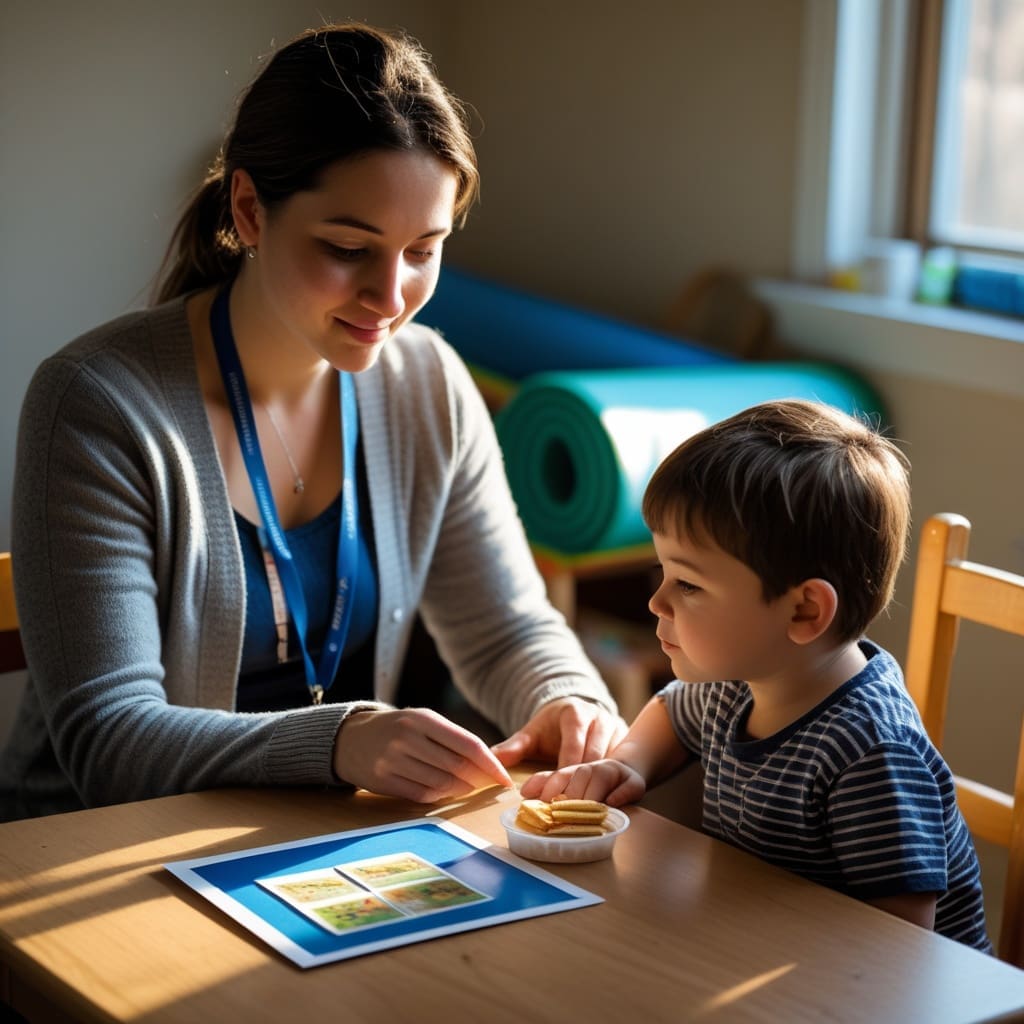
Visual supports remove reliance on verbal reminders. A picture schedule shows each step of a routine with photographs or simple icons. When a child can reference a visual schedule independently, they move through routines without needing constant prompting from a caregiver.
Visual timers (like Time Timer devices) help children understand how long a task takes. This reduces resistance to tasks that feel unpredictable or “endless” to a child who struggles with time perception.
| Age Range | Target Skill | Teaching Method | Visual Support | Independence Indicator |
|---|---|---|---|---|
| 2 to 4 years | Handwashing, removing shoes | Hand-over-hand prompting | Photo sequence strip | Completes with verbal prompt only |
| 4 to 6 years | Dressing, tooth brushing | Backward chaining | Picture schedule on bathroom mirror | Completes independently with schedule |
| 6 to 9 years | Toileting, meal prep basics | Task analysis with video model | Step-by-step visual checklist | Self-initiates without reminder |
| 9 to 12 years | Doing laundry, packing a bag | Video modeling, self-monitoring checklist | Written checklist or app-based prompt | Completes task without adult involvement |
| 12+ years | Meal planning, personal hygiene | Role play, community practice | Digital reminders or smartphone app | Manages routine across multiple days |
How Can You Build Communication Skills in Children With Autism?
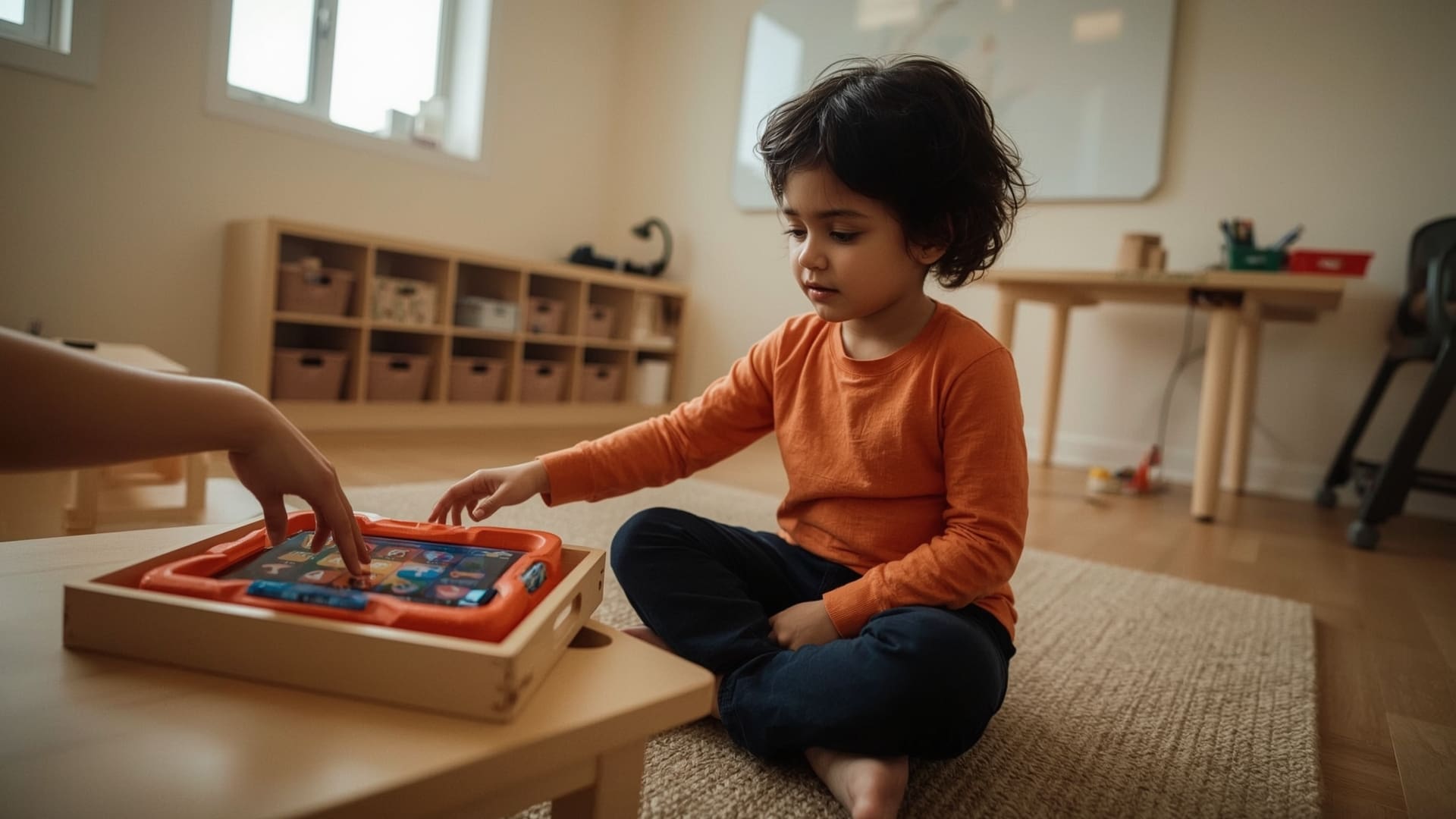
Quick Answer: Build communication by targeting functional language: requesting, refusing, asking for help, and commenting. Use Augmentative and Alternative Communication (AAC) devices for nonverbal children, and focus on teaching communication as a tool to meet real needs rather than drilling isolated words.
Communication is one of the most impactful adaptive skill areas because it affects every other domain. A child who can ask for help will navigate more situations successfully than one who cannot. A child who can say “no” appropriately is safer and more autonomous.
What Is Functional Communication Training (FCT)?
Functional Communication Training (FCT) is an evidence-based approach where children learn to replace challenging behavior with communication. For example, a child who bites when overwhelmed learns to hand a “break” card or press a button on a speech device instead.
FCT works because it addresses the root function of the behavior. If the biting was serving the function of escape, teaching a cleaner escape behavior removes the need for the challenging one. FCT is one of the most researched and widely supported interventions in autism services.
How Does AAC Support Adaptive Communication?
Augmentative and Alternative Communication (AAC) refers to any tool or strategy that supplements or replaces spoken speech. This includes Picture Exchange Communication System (PECS), speech-generating devices (SGDs), and communication apps like Proloquo2Go or TouchChat.
AAC does not prevent speech from developing. Research consistently shows that AAC supports speech development by reducing communication frustration and increasing overall communication attempts. Every child who needs it should have access to an AAC system.
What Are the Key Communication Milestones to Target?
Start with the most functional goals: requesting preferred items, rejecting non-preferred items, getting attention, and reporting information. These four functions cover the bulk of daily communication needs and appear in the early stages of most language development frameworks.
Move toward conversation skills once requesting and rejecting are solid. This includes greetings, turn-taking in conversation, asking questions, and staying on topic. These skills are prerequisites for peer interaction and community participation.
How Do You Teach Socialization Skills to Children With Autism?
Quick Answer: Teach socialization skills through structured social groups, video modeling, and role-playing real-world scenarios. Focus on joint attention, turn-taking, and reading basic social cues before moving to complex skills like making and keeping friendships.
Social skills are not one skill. They are a collection of dozens of smaller abilities that most people learn automatically by watching others. For children with autism, these skills need to be identified individually and taught explicitly.
What Are the Building Blocks of Social Skills for Autistic Children?
Joint attention, the ability to share focus on an object or event with another person, is the earliest and most foundational social skill. Without it, more complex social interaction is very difficult to build. Joint attention develops before language in typical development and is often targeted in early intervention.
After joint attention, target imitation, play skills, and turn-taking. These three skills form the basis of most peer interaction in early childhood. A child who can imitate, play alongside peers, and take turns in simple games has the tools to build friendships.
How Do Social Skills Groups Help Children With Autism?
Social skills groups provide a structured setting where children practice interactions with peers under guided supervision. Programs like PEERS (Program for the Education and Enrichment of Relational Skills), developed at UCLA, have strong research support for adolescents and young adults with autism.
In these groups, children learn specific social rules through direct instruction and then practice them with real peers. The guided feedback loop, where a facilitator helps process what happened and why, is what makes these groups more effective than unstructured peer exposure alone.
What Role Does Play Have in Building Social Skills?
Play is the primary context for social learning in childhood. Structured play activities, like board games, cooperative building tasks, or dramatic play scenarios, create natural opportunities for social skill use without the pressure of unstructured recess or playground settings.
Start with parallel play (playing near someone without direct interaction), move to associative play (sharing materials or commenting), then to cooperative play (working together toward a shared goal). This progression mirrors typical social development and gives the child a clear learning path.
| Social Skill Stage | Target Behaviors | Teaching Strategy | Setting | Measurable Outcome |
|---|---|---|---|---|
| Foundational (Pre-social) | Eye contact, joint attention, imitation | Naturalistic play, reinforcement | Home or clinic 1:1 | Follows joint attention bid 3/5 trials |
| Early Peer Skills | Parallel play, turn-taking, sharing | Structured play with peer model | Small group, 2 to 3 children | Takes turns in 5-step game without prompting |
| Interactive Play | Initiating play, joining groups | Role play with video model review | Social skills group | Initiates play with peer 2x per session |
| Friendship Skills | Conversation, compromise, empathy | PEERS curriculum, structured discussion | School or clinic group | Maintains conversation for 3 exchanges |
How Do You Teach Community Skills to Children With Autism?

Quick Answer: Teach community skills through in-vivo practice, which means practicing in real community settings like grocery stores, buses, and restaurants. Start with structured rehearsal at home or in therapy, then generalize to real environments with graduated support.
Community skills include everything a person needs to function outside the home: using public transportation, making purchases, following safety rules, ordering food, and navigating public spaces. These skills are critical for adult independence and should be introduced well before adulthood.
What Community Safety Skills Should Be Prioritized?
Safety skills come first. These include pedestrian safety (stop, look, cross), stranger awareness (understanding safe vs. unsafe adults), personal identification (name, address, phone number), and emergency response (calling 911, finding a trusted adult).
For children with limited verbal speech, safety instruction should include visual ID cards, medical alert identification, and GPS-enabled devices. These tools extend safety coverage when a child cannot self-advocate verbally.
How Do You Generalize Skills From Therapy to the Real World?
Generalization means a skill transfers across different settings, people, and materials. This is often where progress breaks down. A child may complete a task perfectly in a therapy room but fall apart in the actual grocery store.
To build generalization intentionally, practice skills across multiple settings from the start. Vary the people who give instructions. Use different materials. Change the location. The wider the range of practice, the more robust the skill becomes.
Natural environment teaching (NET), a strategy used in Applied Behavior Analysis (ABA) therapy, embeds skill practice into real-life activities rather than structured table sessions. Research shows this approach produces faster generalization.
How Can Families Practice Community Skills at Home?
Many community skills have home-based equivalents. Paying for a purchase can be practiced with pretend play or a home “store.” Following a bus schedule can be rehearsed with visual sequences before the actual bus ride. Role-playing restaurant ordering reduces anxiety about the real experience.
These practice runs lower the novelty of real-world situations. For children with autism, the unpredictability of community settings is often the biggest barrier, not the skill itself. Rehearsal shrinks that unpredictability.
| Community Skill | Home Practice Method | In-Vivo Setting | Visual Support | Independence Goal |
|---|---|---|---|---|
| Making a purchase | Pretend store with real money | Dollar store or vending machine | Step-by-step visual script | Pays independently, takes change |
| Ordering food | Role-play with menu at home | Fast food counter | Laminated picture menu card | Orders without adult scripting |
| Crossing the street | Backyard or driveway rehearsal | Residential street with adult | Color-coded traffic light visual | Stops, looks, crosses independently |
| Using public transit | Bus schedule reading practice | Local bus route with familiar stop | Route map with highlighted stops | Boards, rides, exits at correct stop |
| Identifying an emergency | 911 role-play at home | Practice with local fire safety program | Emergency contact card | Calls 911 and states name and address |
What Teaching Strategies Work Best for Adaptive Skills in Autism?
Quick Answer: The most effective strategies include task analysis, video modeling, visual supports, naturalistic teaching, and systematic prompt fading. These methods work because they reduce ambiguity, provide structure, and gradually shift control from teacher to learner.
No single strategy works for every child or every skill. Effective adaptive skills teaching combines multiple evidence-based methods and adjusts based on what data shows is working.
What Is Video Modeling and When Should You Use It?
Video modeling involves showing a child a video of someone completing a skill, then having the child practice that skill immediately after. The video provides a consistent, repeatable model that does not change the way a live demonstration might.
Video self-modeling, where the child watches a video of themselves completing the skill successfully, is even more powerful. It builds self-efficacy (the belief that “I can do this”) and has strong research support for children with autism across communication, social, and daily living skills.
How Does Prompt Fading Support Independent Skill Use?
Prompts are any cues that help a child perform a skill: physical guidance, gestures, verbal reminders, or visual cues. Prompt fading is the process of gradually reducing those supports until the child performs the skill independently.
Without systematic fading, children can become prompt-dependent. This means they only perform the skill when someone reminds them, which defeats the goal of independence. Plan for fading from the start of teaching, not as an afterthought.
How Do You Track Progress in Adaptive Skill Development?
Data collection is how you know if a strategy is working. For adaptive skills, common data methods include percent independence (what percentage of steps the child completes without help), trial-by-trial data, and duration data (how long a routine takes).
Review data at least weekly. If progress stalls for two consecutive weeks, change something: the prompt level, the reinforcer, the step size, or the setting. Data removes guesswork and keeps instruction efficient.
| Strategy | Best Used For | Research Support Level | Ease of Implementation | Generalization Strength |
|---|---|---|---|---|
| Task Analysis | Multi-step self-care routines | High (Established) | Moderate (requires planning) | Moderate |
| Video Modeling | Social, communication, daily living | High (Established) | Easy (video recorded once) | High |
| Visual Supports | Routines, transitions, schedules | High (Established) | Easy | Moderate to High |
| Naturalistic Teaching | Communication, play, community | High (Established) | Moderate (requires training) | High |
| Social Stories | Social rules, transitions, new events | Moderate (Emerging) | Easy | Moderate |
| Peer-Mediated Instruction | Social skills, play, communication | High (Established) | Requires peer training | Very High |
How Do Families and Caregivers Support Adaptive Skill Building at Home?

Quick Answer: Families support adaptive skill building by embedding practice into daily routines, staying consistent with strategies the therapy team uses, and gradually stepping back as skills strengthen. Consistency between home and therapy is the single biggest driver of skill generalization.
Therapists see a child for a limited number of hours each week. The rest of the child’s life happens at home and in the community. That means parents and caregivers are the most important teachers a child with autism has.
How Do You Avoid Over-Helping a Child With Autism?
Over-helping, sometimes called learned helplessness, happens when caregivers consistently do tasks for a child instead of supporting them to do it themselves. This is usually well-intentioned. The task is faster, easier, and causes less stress when the adult just does it.
The cost, though, is long-term dependence. Start with “give them a chance first.” Wait three to five seconds before offering a prompt. That pause often reveals what the child can already do independently when given the opportunity.
What Does a Good Home Routine Look Like for Building Independence?
The most effective home routines are predictable, visual, and gradually shifted toward child control. Post a morning routine chart in the bedroom. Post a bath routine chart in the bathroom. Keep the steps consistent so the child builds the routine into memory.
Once a routine is established with visual support, begin fading the visual. First, reduce picture size. Then, move the schedule to a less prominent location. Then remove individual cards. This mirrors the systematic fading process used in therapy and prepares the child for unsupported independence.
How Does Adaptive Skill Development Connect to Long-Term Independence?
Quick Answer: Adaptive skills developed in childhood directly predict adult independence outcomes. Research shows that adaptive behavior scores in childhood are stronger predictors of adult employment and quality of life than IQ scores alone for autistic individuals.
The earlier adaptive skills are targeted, the more time a child has to practice and strengthen them before the demands of adulthood arrive. Transition planning, which under IDEA law begins no later than age 16 in the U.S., should build directly on the adaptive skill foundation established in childhood.
What Adaptive Skills Matter Most for Adult Independence?
Research on adult outcomes for autistic individuals consistently points to a core set of functional skills: managing personal finances, using transportation, cooking, maintaining personal hygiene, and navigating workplace social norms. These are all teachable with the right supports starting in middle childhood.
Vocational skills, which include following multi-step work tasks, accepting feedback, and managing time, can and should be introduced before adulthood. School-based programs, community-based work experience, and supported employment services all provide pathways toward employment independence.
How Should Transition Planning Address Adaptive Skills?
A strong transition plan identifies the specific adaptive skills a young person needs for their post-school goals, whether that is supported living, independent living, post-secondary education, or competitive employment. Each goal should map to specific, measurable adaptive skill targets.
The team writing the transition plan should include the student as an active participant. Autistic young adults who are involved in their own goal-setting show stronger outcomes. Their priorities, interests, and strengths must drive the plan.
Frequently Asked Questions About Adaptive Skills and Autism
Can adaptive skills improve throughout adulthood for autistic individuals?
Yes. Adaptive skills can develop at any age with the right instruction and support. Adults with autism who receive targeted skill training through supported living programs, vocational rehabilitation, or ongoing behavioral services continue to make meaningful progress. Development does not stop at 18.
What is the difference between adaptive skills and life skills?
The terms overlap significantly, but adaptive skills is the clinical term used in standardized assessments and diagnostic criteria. Life skills is the everyday term most people use. Adaptive skills includes communication, socialization, and community functioning in addition to personal care, making it a broader category than what most people picture when they hear “life skills.”
Do all children with autism have the same adaptive skill needs?
No. Autism is a spectrum, and adaptive skill profiles vary widely. One child may have strong communication skills but need significant support with self-care. Another may dress and eat independently but struggle with community safety. Assessment tools like the Vineland-3 identify each child’s specific profile rather than applying a one-size-fits-all approach.
How does an IEP address adaptive skills for a child with autism?
An IEP (Individualized Education Program) can include adaptive skill goals across self-care, communication, and community domains. These goals must be measurable and tied to the child’s current performance level. Related services like occupational therapy and speech-language pathology often support adaptive skill targets directly within the IEP framework.
What role does occupational therapy play in adaptive skill development?
Occupational therapists (OTs) specialize in the motor, sensory, and functional skills that underlie adaptive behavior. An OT might address fine motor skills needed for dressing, sensory regulation strategies that make self-care tolerable, or handwriting skills that support academic independence. OT and ABA therapy often work together to address adaptive skill goals from complementary angles.
How long does it take to build a new adaptive skill in a child with autism?
Timelines vary based on the skill’s complexity, how often it is practiced, and the child’s current skill level. Simple skills practiced daily, like handwashing, can be mastered in two to six weeks with consistent instruction. Complex multi-environment skills, like using public transportation independently, may take several months to a year of structured practice before full independence is achieved.